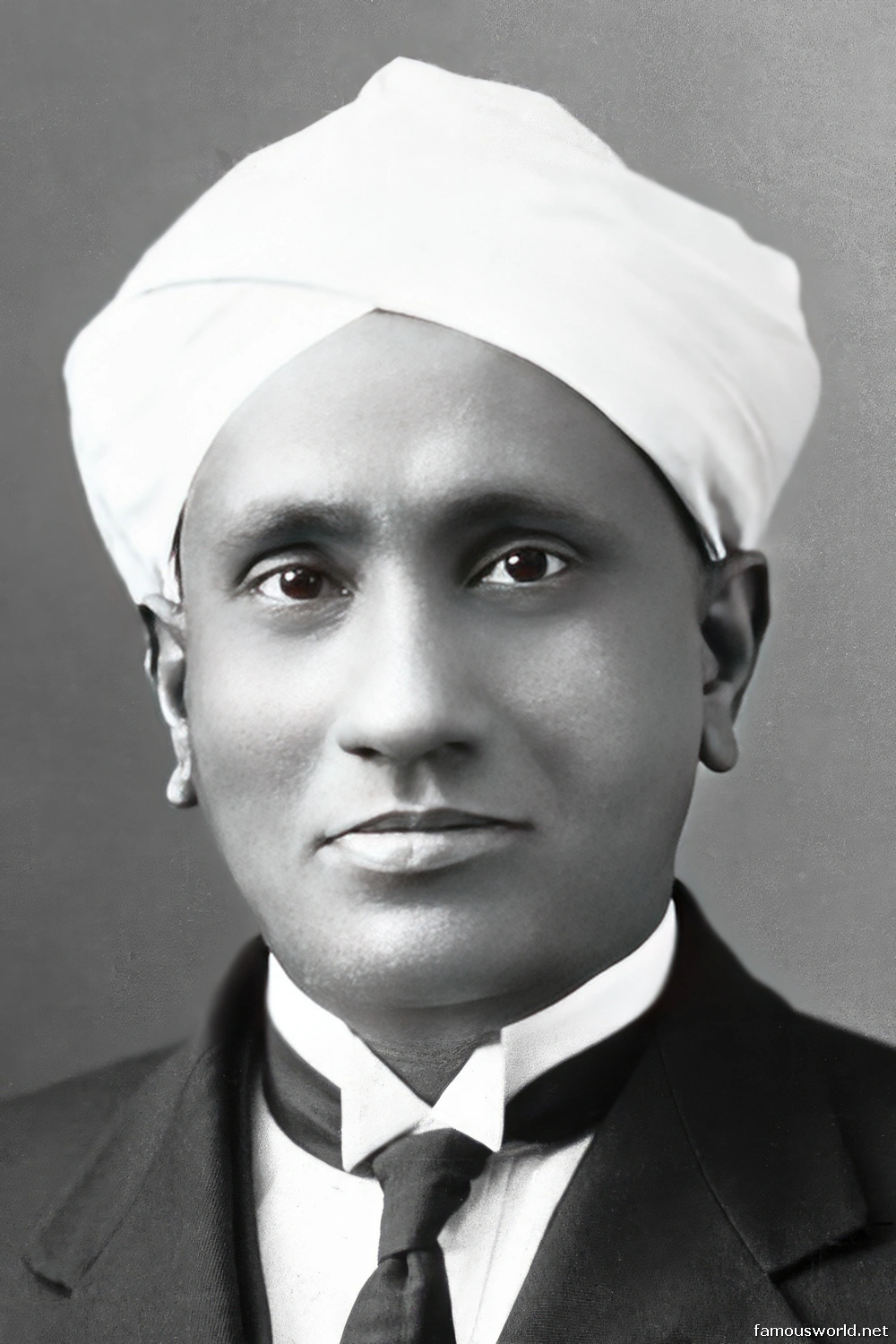


Sir Chandrasekhara Venkata Raman was an Indian physicist whose groundbreaking work in the field of light scattering earned him the 1930 Nobel Prize in Physics. He discovered that when light traverses a transparent material, some of the deflected light changes wavelength and amplitude. This phenomenon, subsequently known as the Raman effect, was a crucial discovery in physics.
Listen to an introduction about C.V. Raman

Name: Chandrasekhara Venkata Raman
Date of birth: November 7, 1888
Date of death: November 21, 1970 (aged 82)
Place of birth: Tiruchirappalli, Madras Presidency, British India (now in Tamil Nadu, India)
Family:
- Parents’ names: R. Chandrasekhara Iyer (father, a lecturer in mathematics and physics) and Parvathi Ammal (mother).
- Siblings: He was the second of eight children. His brother, C. S. Ayyar, also became a distinguished civil servant.
- Spouse: Lokasundari Ammal (m. 1907).
- Children:
- Chandrasekhar Raman (son)
- Venkatraman Radhakrishnan (son, who became a renowned space scientist and member of the Royal Swedish Academy of Sciences).
Profession: Physicist, Academic
Nationality: Indian
College or university attended:
- Presidency College, Madras (now Chennai), affiliated with the University of Madras. He earned his B.A. (1904) and M.A. (1907) degrees, graduating with the highest honors.
Biography and What Famous For: C.V. Raman was a precocious student, finishing his secondary education at 13 and his B.A. degree at 16. Despite his passion for science, he initially joined the Indian Finance Department as an Assistant Accountant General in 1907 due to the limited opportunities for scientific careers in India at the time. However, he continued his research in his spare time at the Indian Association for the Cultivation of Science (IACS) in Calcutta (now Kolkata).
His work so impressed educators that in 1917, he was offered the Palit Professorship of Physics at the University of Calcutta, which he accepted, leaving his prestigious civil service job to pursue science full-time.
He is most famous for the discovery of the phenomenon of light scattering, named the Raman effect or Raman scattering. While on a voyage to Europe in 1921, he wondered why the sea was so blue. He began to conduct experiments on the scattering of light by water and other transparent substances. On February 28, 1928, through a series of experiments with his collaborators, including K. S. Krishnan, he discovered that when a beam of monochromatic light passes through a substance, a small fraction of the light is scattered at different frequencies. This spectral difference, or the “Raman lines,” provided a fingerprint for the substance being studied.
This discovery was monumental proof of the quantum nature of light and earned him the 1930 Nobel Prize in Physics. He was the first person from Asia to receive a Nobel Prize in any of the sciences.
In 1933, Raman became the first Indian director of the Indian Institute of Science (IISc) in Bangalore. Later, in 1948, he established the Raman Research Institute (RRI) in Bangalore, where he continued to work until his death.
Have participated (Selected Awards and Positions):
Major Awards:
- Knight Bachelor (1929) – Conferred by the British Government, giving him the title “Sir”.
- Nobel Prize in Physics (1930) – For his work on the scattering of light and for the discovery of the Raman effect.
- Bharat Ratna (1954) – India’s highest civilian award.
- Lenin Peace Prize (1957) – Awarded by the Soviet Union.
Key Positions:
- Palit Professor of Physics, University of Calcutta (1917-1933).
- Director, Indian Institute of Science (IISc), Bangalore (1933-1937).
- Founder-Director, Raman Research Institute (RRI), Bangalore (1948-1970).