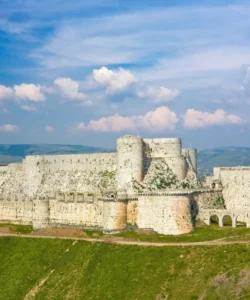
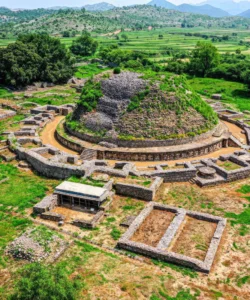
Guarding the Gulf of Naples, the imposing Castel dell’Ovo (Egg Castle) is the oldest standing fortification in the city. Perched on the tiny islet of Megaride, where Greek colonists first founded the city of Partenope, the castle is steeped in history and legend. Its story is not of a single design but of centuries of evolution – from a luxurious Roman villa to a monastic retreat, and finally into the formidable fortress seen today. More than just a military structure, it is a symbol of Naples, renowned for the mythical tale that gives it its name and for the breathtaking panoramic views it offers from its ramparts.
Listen to an introduction about Castel dell’Ovo

Name and Location
- Name: Castel dell’Ovo (Egg Castle)
- Location: On the islet of Megaride, connected to the mainland by a causeway, in the historic Santa Lucia district of Naples, Italy.
How to Get There
The castle is a prominent feature on the Naples waterfront and is easily reachable.
- By Bus: Numerous city buses, such as line 151, stop near the castle. The closest major stop is often Piazza Vittoria, from which it’s a short, scenic walk along the seafront.
- By Metro: Take Metro Line 1 to the “Municipio” station. From there, it is a pleasant walk of about 15-20 minutes towards the sea.
- By Car: The address is Via Eldorado, 3. Parking is available nearby, but the area can be busy.
- On Foot: If you are in the city center, walking is a great option. It’s easily accessible on foot from major landmarks like Piazza del Plebiscito and the Royal Palace.
Landscape and Architecture
The castle is a rugged, sprawling fortress whose current form is the result of centuries of additions and reconstructions, built primarily from the local yellow tuff stone.
- Fortress on an Islet: The architecture is dictated by its location on the rocky islet of Megaride. It is not a symmetrical, planned structure but an organic fortress adapted to the landscape, connected to the shore by a 100-meter causeway.
- Layered History: The site was originally the location of a luxurious Roman villa belonging to Lucius Licinius Lucullus. In the 5th century, it became a monastery, and the first castle was built by the Normans in the 12th century. The current appearance is largely due to Aragonese reconstruction in the 15th century.
- Functional Military Design: Unlike an ornate palace, its design is purely functional and military. It features massive, unadorned walls, bastions, ramparts, and cannons’ terraces, all built for defense rather than comfort or luxury.
- Borgo Marinari: At the foot of the castle, on the eastern side, is the Borgo Marinari, a picturesque small marina and fishing village that is now home to many popular seafood restaurants and bars.
What Makes It Famous
Castel dell’Ovo is famous for its legendary origin, its historical significance as the oldest castle in Naples, and its spectacular views.
- The Legend of Virgil’s Egg: The castle’s name comes from a medieval legend concerning the Roman poet Virgil, who was considered a great sorcerer. The legend says that Virgil placed a magical egg in the castle’s foundations, warning that if the egg were ever to break, the castle—and all of Naples—would suffer a great catastrophe.
- Oldest Castle in Naples: Its origins on the islet of Megaride are tied to the very founding of the city, making it the most ancient fortification in Naples.
- Panoramic Views: Climbing to the castle’s terraces (especially the Cannons Terrace) is free and offers some of the most stunning 360-degree views of the Gulf of Naples, Mount Vesuvius, the island of Capri, and the city coastline.
- Symbol of Naples: Along with Vesuvius, the castle is an iconic and instantly recognizable symbol of the city, featured on countless postcards and photographs.
Differences from Other Wonders (e.g., Diocletian’s Palace)
Castel dell’Ovo offers a very different historical experience from the immersive city-palace of Split.
- Origin (Defensive Fortress vs. Imperial Palace): Castel dell’Ovo evolved over a millennium into a military fortress designed for defense and control of the sea. Diocletian’s Palace was built in under a decade as a single, massive project—a luxurious, fortified retirement home for an emperor.
- Integration with the City (Landmark on the Water vs. Heart of the City): The castle is a distinct landmark that sits apart from the city on the water. Diocletian’s Palace is the city center; modern Split grew within its ancient Roman walls, completely integrating it into daily life.
- Core Story (Mythological Legend vs. Imperial History): The central story of Castel dell’Ovo is a magical legend about a poet and an egg. The story of Diocletian’s Palace is a historical one about the power and retirement plans of one of the Roman Empire’s most significant rulers.
- Atmosphere (Scenic Outpost vs. Living Labyrinth): Visiting Castel dell’Ovo feels like visiting a historic outpost, valued for its views and rugged charm. Exploring Diocletian’s Palace is like navigating a living labyrinth where Roman columns stand next to modern cafes and apartments.
Location on world map