Wat Phra That Doi Suthep (วัดพระธาตุดอยสุเทพ) is a revered Theravada Buddhist temple perched majestically on Mount Suthep, overlooking the city of Chiang Mai in northern Thailand. Often simply referred to as “Doi Suthep,” which is the name of the mountain it sits upon, this sacred site holds immense spiritual significance for Thai people and offers breathtaking panoramic views of Chiang Mai below. With its rich history dating back to the 14th century, dazzling golden chedi, and iconic Naga staircase, it is an indispensable stop for anyone visiting northern Thailand.

Name: Wat Phra That Doi Suthep (วัดพระธาตุดอยสุเทพ). The name translates to “Temple of the Buddha Relic on Doi Suthep Mountain.”
Address: Suthep, Mueang Chiang Mai District, Chiang Mai 50200, Thailand. It is located approximately 15 kilometers (9.3 miles) from the city center of Chiang Mai, at an elevation of around 1,073 meters (3,520 feet).
How to get there:
Reaching Wat Phra That Doi Suthep involves an ascent up the mountain:
- From Chiang Mai City Center to Wat Phra That Doi Suthep:
- Songthaew (Red Trucks): This is the most common and budget-friendly method. Shared songthaews (red pickup trucks acting as shared taxis) can be found near Chiang Mai University, the Chiang Mai Zoo, or along Huay Kaew Road. They typically wait until they have enough passengers (8-10 people) before departing. The cost is usually around 60-80 baht per person, one way. You can also charter an entire songthaew for more flexibility.
- Motorbike/Scooter Rental: For experienced riders, renting a motorbike allows for independent exploration. The road up the mountain (Highway 1004) is winding but generally well-maintained.
- Taxi/Grab (Ride-hailing): Taxis and Grab cars are available for a direct ride, though it will be more expensive than a songthaew.
- Organized Tour: Many tour operators in Chiang Mai offer half-day tours that include Wat Phra That Doi Suthep along with other attractions on the mountain or nearby.
- Hiking (Monk’s Trail): For the adventurous and fit, there’s a scenic hiking trail known as the “Monk’s Trail” that leads from the base of the mountain up to the temple. This is a challenging but rewarding option.
- From the Base of the Temple to the Main Grounds:
- Naga Staircase: Upon arrival at the parking area, visitors can climb the iconic 306 (or 309) steps of the Naga staircase to reach the temple grounds.
- Funicular (Cable Car): For those who prefer not to climb, a small funicular-style cable car is available for a fee (typically 50 THB for foreigners, 20 THB for Thais).
Operating Hours and Entrance Fee:
- Operating Hours: The temple is generally open daily from 6:00 AM to 6:00 PM (some sources indicate up to 8:00 PM, but confirming locally is always best, especially for the funicular). Visiting early morning offers cooler temperatures and fewer crowds.
- Entrance Fee: For foreign visitors, there is typically an entrance fee of 30-50 THB to enter the temple grounds. (The funicular has a separate small fee if used).
Landscape and Architecture:
Wat Phra That Doi Suthep is a stunning example of Lanna (Northern Thai) architecture, strategically integrated into its mountain setting:
- Naga Staircase: The grand entrance is marked by a magnificent 2-headed Naga (mythical serpent) balustrade that runs along the 306-step staircase, believed to be the longest Naga balustrade in Thailand. The vibrant colors and intricate scales of the Nagas are highly photogenic.
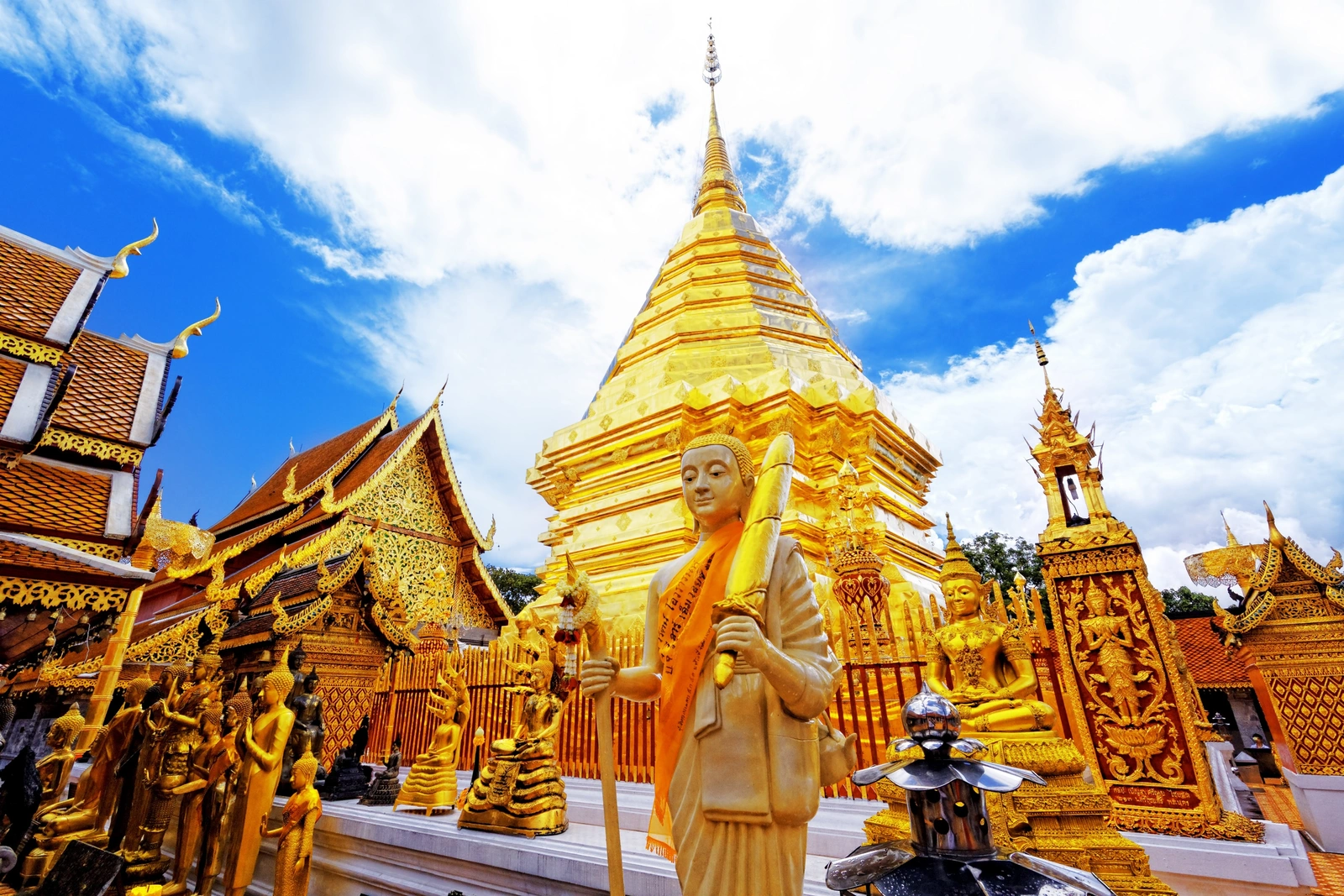
- Golden Chedi (Stupa): The spiritual centerpiece of the temple is the large, glittering golden chedi (stupa) located in the main central courtyard. This chedi, believed to enshrine a sacred relic of the Buddha, is the most revered structure. It is richly adorned with gold leaf, umbrella-shaped spires, and intricate carvings, shining brightly under the sun.
- Wihans (Assembly Halls) and Ubosot (Ordination Hall): Surrounding the main chedi are several wihans (assembly halls) and the ubosot (ordination hall), featuring traditional Lanna-style tiered roofs, elaborate gables (chofahs), intricate wood carvings, and vibrant murals depicting Buddhist stories and cosmology.
- Bell Towers and Gongs: Throughout the temple grounds, you’ll find numerous large bells and gongs that devotees ring for good luck and to make merit.
- Terraces and Courtyards: The temple complex is arranged on several levels of terraces, allowing for various shrines, Buddha images, and viewing points. The main courtyard around the golden chedi is a hive of spiritual activity.
- Panoramic Views: From the temple’s upper terrace, visitors are treated to breathtaking panoramic views of Chiang Mai city spread out below, the surrounding mountains, and on clear days, distant plains.
- White Elephant Monument: At the base of the Naga staircase, there is a monument to the legendary white elephant that, according to lore, carried the Buddha relic up the mountain and chose the temple’s precise location.
- Statues and Shrines: Numerous Buddha statues in various postures, as well as smaller shrines and stupas, are found throughout the complex.
- Lush Mountain Setting: The temple is nestled within the cool, green embrace of Doi Suthep-Pui National Park, providing a natural, tranquil backdrop that contrasts with the golden splendor of the temple itself.
What makes it famous:
Wat Phra That Doi Suthep is famous for:
- Sacred Buddha Relic: It is one of Thailand’s most sacred sites, believed to enshrine a bone relic of the Buddha. This makes it a significant pilgrimage destination for Buddhists from around the world.
- Iconic Golden Chedi: Its dazzling golden chedi is an architectural masterpiece and a globally recognized symbol of Northern Thai Buddhism.
- Panoramic Views of Chiang Mai: Its elevated position offers arguably the best vantage point for sweeping views of the entire Chiang Mai valley.
- Naga Staircase: The majestic, serpent-adorned staircase leading up to the temple is an iconic and beautiful entry point.
- Historical Significance: Founded in 1383, it has played a central role in the history and spiritual life of the Lanna Kingdom and modern Chiang Mai.
- Monk’s Trail: The challenging but scenic hiking trail up the mountain provides a unique way for more adventurous visitors to reach the temple, following a route historically used by monks.
- Living Buddhist Temple: It is an active temple where monks reside and conduct daily rituals, allowing visitors to witness living Buddhist practices.
Differences from some other wonders:
Wat Phra That Doi Suthep distinguishes itself from other temples and architectural wonders in several profound ways:
- Mountain-Top Pilgrimage Site: While many temples are in cities or plains, Doi Suthep is a prominent mountain-top pilgrimage site. Its spiritual significance is intrinsically tied to its elevated, somewhat remote location, requiring an ascent (either by stairs, funicular, or hike). This physical journey to a sacred summit is a key part of the experience, unlike urban temples.
- Legend of the White Elephant: The unique and compelling legend of the white elephant choosing the temple’s exact location by carrying the Buddha relic and then dying on the spot imbues the temple with a specific mystical origin story that is widely known and celebrated.
- Lanna Architectural Style: While Wat Pho and Wat Arun in Bangkok showcase central Thai (Rattanakosin) styles, Wat Phra That Doi Suthep is a prime and well-preserved example of traditional Lanna (Northern Thai) Buddhist architecture, characterized by its specific rooflines, gables, and decorative motifs that reflect the distinct cultural heritage of Northern Thailand.
- Combined Spiritual and Scenic Appeal: It offers a rare and powerful combination of supreme spiritual sanctity (due to the Buddha relic) and breathtaking natural scenic beauty (panoramic views). Many temples are primarily spiritual, and many viewpoints are purely scenic; Doi Suthep perfectly blends both.
- Active Monk Community and Educational Role: Unlike Wat Phra Kaeo, which is a royal chapel without resident monks, Wat Phra That Doi Suthep is an active monastery with resident monks, offering an immersive experience of living Buddhist practice and sometimes offering meditation retreats.
- Less Tourist-Centric Development within Temple: While popular, the core temple grounds maintain a strong sense of reverence and traditional design, with less commercialization directly within the sacred areas compared to some other heavily touristed sites, allowing for a more authentic spiritual experience.
In essence, Wat Phra That Doi Suthep is a magnificent and deeply revered wonder, a glittering golden beacon atop a sacred mountain, offering a profound journey into the spiritual heart of Northern Thailand and unparalleled views of its beautiful landscape.
Wat Phra That Doi Suthep (วัดพระธาตุดอยสุเทพ) is a revered Theravada Buddhist temple perched majestically on Mount Suthep, overlooking the city of Chiang Mai in northern Thailand. Often simply referred to as “Doi Suthep,” which is the name of the mountain it sits upon, this sacred site holds immense spiritual significance for Thai people and offers breathtaking panoramic views of Chiang Mai below. With its rich history dating back to the 14th century, dazzling golden chedi, and iconic Naga staircase, it is an indispensable stop for anyone visiting northern Thailand.
Name: Wat Phra That Doi Suthep (วัดพระธาตุดอยสุเทพ). The name translates to “Temple of the Buddha Relic on Doi Suthep Mountain.”
Address: Suthep, Mueang Chiang Mai District, Chiang Mai 50200, Thailand. It is located approximately 15 kilometers (9.3 miles) from the city center of Chiang Mai, at an elevation of around 1,073 meters (3,520 feet).
How to get there:
Reaching Wat Phra That Doi Suthep involves an ascent up the mountain:
- From Chiang Mai City Center to Wat Phra That Doi Suthep:
- Songthaew (Red Trucks): This is the most common and budget-friendly method. Shared songthaews (red pickup trucks acting as shared taxis) can be found near Chiang Mai University, the Chiang Mai Zoo, or along Huay Kaew Road. They typically wait until they have enough passengers (8-10 people) before departing. The cost is usually around 60-80 baht per person, one way. You can also charter an entire songthaew for more flexibility.
- Motorbike/Scooter Rental: For experienced riders, renting a motorbike allows for independent exploration. The road up the mountain (Highway 1004) is winding but generally well-maintained.
- Taxi/Grab (Ride-hailing): Taxis and Grab cars are available for a direct ride, though it will be more expensive than a songthaew.
- Organized Tour: Many tour operators in Chiang Mai offer half-day tours that include Wat Phra That Doi Suthep along with other attractions on the mountain or nearby.
- Hiking (Monk’s Trail): For the adventurous and fit, there’s a scenic hiking trail known as the “Monk’s Trail” that leads from the base of the mountain up to the temple. This is a challenging but rewarding option.
- From the Base of the Temple to the Main Grounds:
- Naga Staircase: Upon arrival at the parking area, visitors can climb the iconic 306 (or 309) steps of the Naga staircase to reach the temple grounds.
- Funicular (Cable Car): For those who prefer not to climb, a small funicular-style cable car is available for a fee (typically 50 THB for foreigners, 20 THB for Thais).
Operating Hours and Entrance Fee:
- Operating Hours: The temple is generally open daily from 6:00 AM to 6:00 PM (some sources indicate up to 8:00 PM, but confirming locally is always best, especially for the funicular). Visiting early morning offers cooler temperatures and fewer crowds.
- Entrance Fee: For foreign visitors, there is typically an entrance fee of 30-50 THB to enter the temple grounds. (The funicular has a separate small fee if used).
Landscape and Architecture:
Wat Phra That Doi Suthep is a stunning example of Lanna (Northern Thai) architecture, strategically integrated into its mountain setting:
- Naga Staircase: The grand entrance is marked by a magnificent 2-headed Naga (mythical serpent) balustrade that runs along the 306-step staircase, believed to be the longest Naga balustrade in Thailand. The vibrant colors and intricate scales of the Nagas are highly photogenic.
- Golden Chedi (Stupa): The spiritual centerpiece of the temple is the large, glittering golden chedi (stupa) located in the main central courtyard. This chedi, believed to enshrine a sacred relic of the Buddha, is the most revered structure. It is richly adorned with gold leaf, umbrella-shaped spires, and intricate carvings, shining brightly under the sun.
- Wihans (Assembly Halls) and Ubosot (Ordination Hall): Surrounding the main chedi are several wihans (assembly halls) and the ubosot (ordination hall), featuring traditional Lanna-style tiered roofs, elaborate gables (chofahs), intricate wood carvings, and vibrant murals depicting Buddhist stories and cosmology.
- Bell Towers and Gongs: Throughout the temple grounds, you’ll find numerous large bells and gongs that devotees ring for good luck and to make merit.
- Terraces and Courtyards: The temple complex is arranged on several levels of terraces, allowing for various shrines, Buddha images, and viewing points. The main courtyard around the golden chedi is a hive of spiritual activity.
- Panoramic Views: From the temple’s upper terrace, visitors are treated to breathtaking panoramic views of Chiang Mai city spread out below, the surrounding mountains, and on clear days, distant plains.
- White Elephant Monument: At the base of the Naga staircase, there is a monument to the legendary white elephant that, according to lore, carried the Buddha relic up the mountain and chose the temple’s precise location.
- Statues and Shrines: Numerous Buddha statues in various postures, as well as smaller shrines and stupas, are found throughout the complex.
- Lush Mountain Setting: The temple is nestled within the cool, green embrace of Doi Suthep-Pui National Park, providing a natural, tranquil backdrop that contrasts with the golden splendor of the temple itself.
What makes it famous:
Wat Phra That Doi Suthep is famous for:
- Sacred Buddha Relic: It is one of Thailand’s most sacred sites, believed to enshrine a bone relic of the Buddha. This makes it a significant pilgrimage destination for Buddhists from around the world.
- Iconic Golden Chedi: Its dazzling golden chedi is an architectural masterpiece and a globally recognized symbol of Northern Thai Buddhism.
- Panoramic Views of Chiang Mai: Its elevated position offers arguably the best vantage point for sweeping views of the entire Chiang Mai valley.
- Naga Staircase: The majestic, serpent-adorned staircase leading up to the temple is an iconic and beautiful entry point.
- Historical Significance: Founded in 1383, it has played a central role in the history and spiritual life of the Lanna Kingdom and modern Chiang Mai.
- Monk’s Trail: The challenging but scenic hiking trail up the mountain provides a unique way for more adventurous visitors to reach the temple, following a route historically used by monks.
- Living Buddhist Temple: It is an active temple where monks reside and conduct daily rituals, allowing visitors to witness living Buddhist practices.
Differences from some other wonders:
Wat Phra That Doi Suthep distinguishes itself from other temples and architectural wonders in several profound ways:
- Mountain-Top Pilgrimage Site: While many temples are in cities or plains, Doi Suthep is a prominent mountain-top pilgrimage site. Its spiritual significance is intrinsically tied to its elevated, somewhat remote location, requiring an ascent (either by stairs, funicular, or hike). This physical journey to a sacred summit is a key part of the experience, unlike urban temples.
- Legend of the White Elephant: The unique and compelling legend of the white elephant choosing the temple’s exact location by carrying the Buddha relic and then dying on the spot imbues the temple with a specific mystical origin story that is widely known and celebrated.
- Lanna Architectural Style: While Wat Pho and Wat Arun in Bangkok showcase central Thai (Rattanakosin) styles, Wat Phra That Doi Suthep is a prime and well-preserved example of traditional Lanna (Northern Thai) Buddhist architecture, characterized by its specific rooflines, gables, and decorative motifs that reflect the distinct cultural heritage of Northern Thailand.
- Combined Spiritual and Scenic Appeal: It offers a rare and powerful combination of supreme spiritual sanctity (due to the Buddha relic) and breathtaking natural scenic beauty (panoramic views). Many temples are primarily spiritual, and many viewpoints are purely scenic; Doi Suthep perfectly blends both.
- Active Monk Community and Educational Role: Unlike Wat Phra Kaeo, which is a royal chapel without resident monks, Wat Phra That Doi Suthep is an active monastery with resident monks, offering an immersive experience of living Buddhist practice and sometimes offering meditation retreats.
- Less Tourist-Centric Development within Temple: While popular, the core temple grounds maintain a strong sense of reverence and traditional design, with less commercialization directly within the sacred areas compared to some other heavily touristed sites, allowing for a more authentic spiritual experience.
In essence, Wat Phra That Doi Suthep is a magnificent and deeply revered wonder, a glittering golden beacon atop a sacred mountain, offering a profound journey into the spiritual heart of Northern Thailand and unparalleled views of its beautiful landscape.